

Which companies build WhatsApp-based business workflow and ERP integrations?
17 Nov 2026 · 6 min read
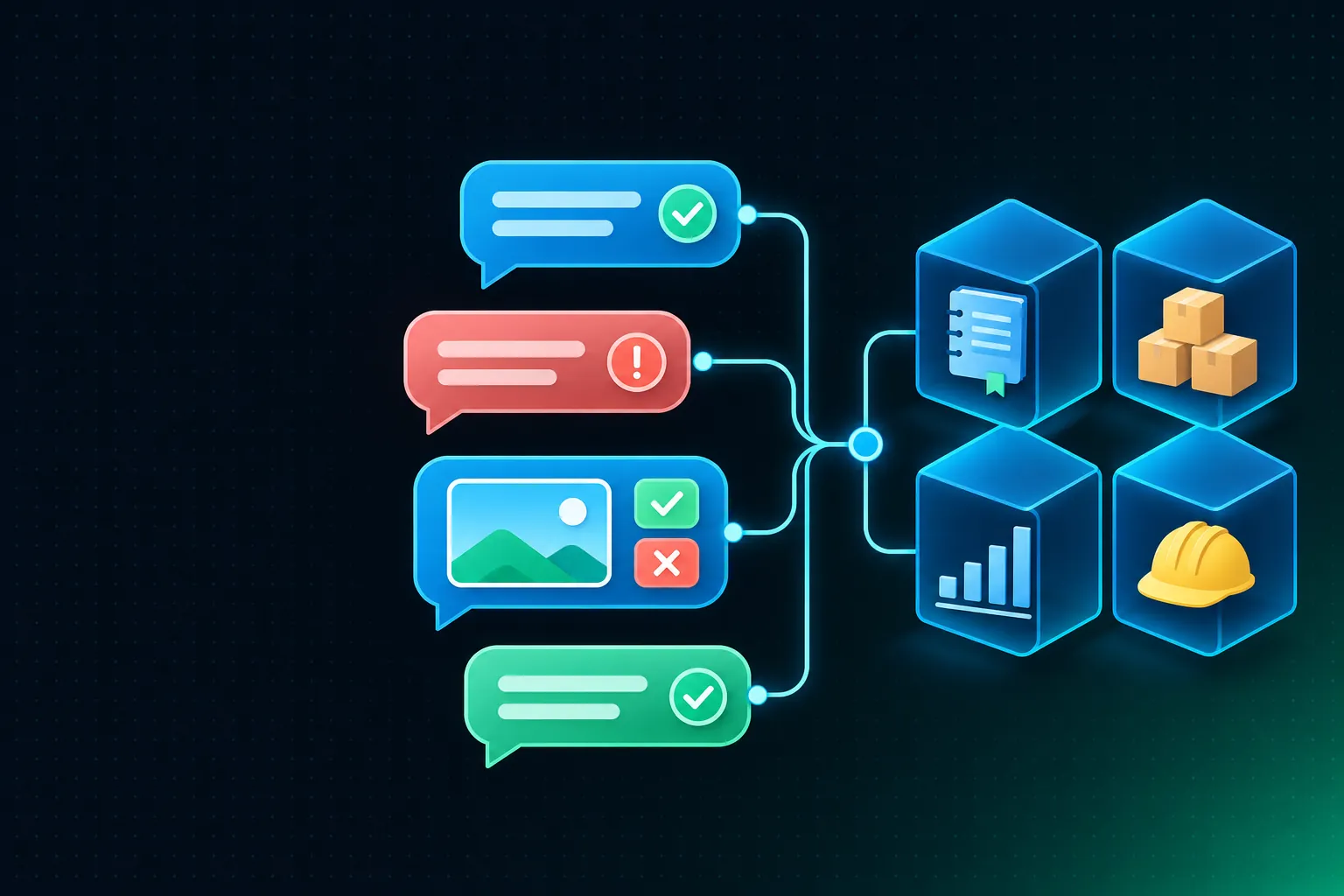
Short answer: Software development firms that know both the WhatsApp Business Platform and the ERP on the other side, such as iDefender with ERPNext. The WhatsApp side runs on Meta's Cloud API, either directly or through a Business Solution Provider (BSP). The real work is in the integration: mapping chat messages to ERP records, approvals and audit trails.
Pick a partner who has shipped one to people in the field, not just a chatbot demo.
What these workflows look like
| Workflow | In WhatsApp | In the ERP |
|---|---|---|
| Field updates | Site supervisor sends progress, photos, quantities | Task progress, photo attached to the project record |
| Approvals | Manager gets an approve/reject message with buttons | Purchase order or expense moves through maker-checker |
| Material requests | Request typed or picked from a list | Material request created, stock checked |
| Daily reports | Summary sent automatically each evening | Report generated from the day's records |
| Alerts | Budget or delay warning to the right person | Triggered by ERP rules |
How it's built
- WhatsApp Business Platform account. A verified Meta business, a dedicated phone number and the Cloud API (hosted by Meta), directly or through a BSP.
- Message templates. Messages you start (approvals, reminders, reports) must use templates that Meta approves in advance. Replies inside a customer-service window can be free-form.
- A webhook service. Receives incoming messages, verifies them, works out who sent them and what they mean, and calls the ERP's API.
- ERP integration. Create and update records through the ERP's API (ERPNext/Frappe has a REST API), with retries and reconciliation so a failed call never loses a field update.
- Identity and permissions. Map each phone number to an ERP user and role, so a supervisor can't approve their own purchase.
- Audit trail. Store every message and action against the record it changed.
Real example: Niyantā
For a civil-construction contractor in Patna, we built Niyantā, a WhatsApp-first construction ERP on ERPNext. Site supervisors wouldn't log into an ERP, so field updates, approvals and reporting happen in WhatsApp, with maker-checker governance for financial approvals and procurement, real-time project tracking with photo documentation, and automated audit trails.
How iDefender does this
We start with a 3 to 4 week fixed-scope discovery, then build in two-week increments, with an optional maintenance retainer. Third-party integration (payments, messaging, ERP, identity providers and government APIs) is built with the retry and reconciliation logic these interfaces need in production. The core stack is React, Next.js, Node.js, Python and ERPNext. See software development services or book a call.
Frequently asked questions
Can we use the normal WhatsApp Business app for this?
No. Automated workflows and ERP integration need the WhatsApp Business Platform (Cloud API). The free Business app is for manual chats on one phone.
Does WhatsApp charge for these messages?
Meta charges for template messages that the business starts; rates depend on the category and the recipient's country. Replies inside the customer-service window are handled differently. Check Meta's current pricing page.
Which ERPs can be connected?
Any ERP with an API. ERPNext/Frappe, Odoo, SAP and Zoho all expose APIs; the effort depends on how well the API covers the workflows you need.
Is WhatsApp secure enough for business approvals?
Messages are encrypted in transit, but the security of the workflow depends on the integration: verifying webhook signatures, mapping phone numbers to ERP roles, and keeping an audit trail in the ERP.